


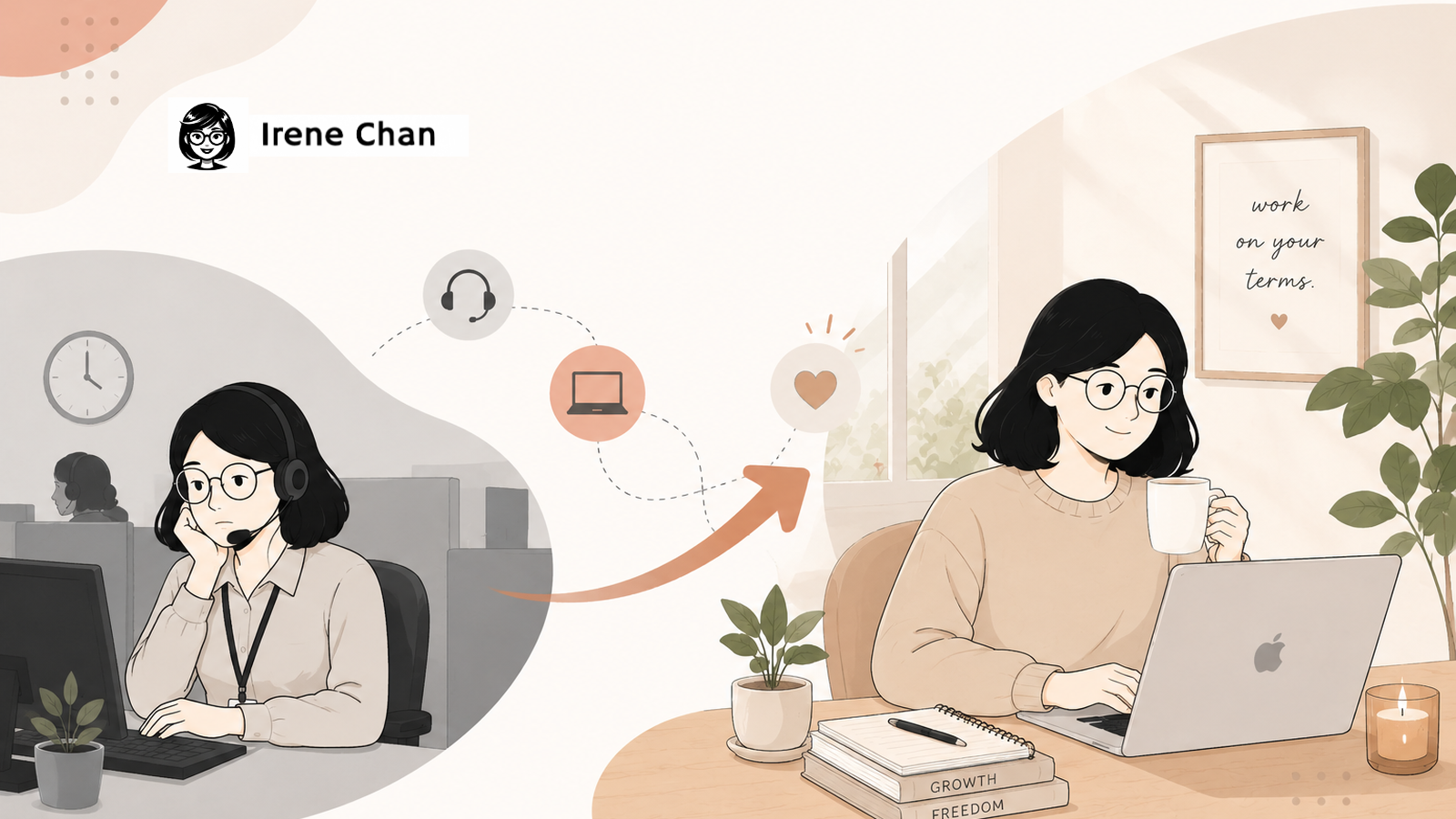
The commute was almost four hours a day. Two hours to get there, two hours back. I was 19, working at an Apple call center through Teleperformance, picking up the same calls over and over. Customer after customer with the same problems. The same scripts. The same exhaustion of having to be nice to people who weren’t always being nice back.
I did it anyway, for four months, including a month of training. But I knew from the beginning it was temporary. I had a plan. Save money, move to Ukraine, learn the language, and explore my roots. My mom is Ukrainian, and I’ve loved that country since I was a kid. This job wasn’t my life. It was a stepping stone.
What I didn’t know then was how much I’d hate the repetition.
Boredom as a Signal
I have a creative mind that needs challenge, that needs things to change, that gets restless with the mundane. It’s not a personality quirk. It’s how I’m wired.
Growing up, I worked summers at my dad’s shop. Making coffee, making sandwiches, and cleaning. It taught me about customer service, about showing up, about work. But it also showed me something else: I needed more.
When I left the Apple job and moved to Ukraine in the autumn of 2019, I thought I was moving toward something. Learning my heritage. Speaking my mother’s language. Understanding a part of myself. What I didn’t realize was that I was also running from something, the soul-crushing monotony of customer support work that treated me like a machine.
In Ukraine, I found another customer support job, but the pattern was the same. Emails, chats, phone calls. Low pay. Too much work. The work piled up, and I felt stuck again.
Then, in the autumn of 2020, I started at Be.Live as a customer support representative. Be.Live was a startup, which meant something important: there was room to move. There was room to try new things and be more than one role.
Somewhere along the way, while I was still managing customer support, I started writing blog posts for the company. I took mini courses in SEO, content writing, and marketing. I discovered something: I didn’t hate work. I hated repetition, shifts, and the feeling of being trapped in a box doing the same thing over and over.
Writing was different. Every article was new. Every project had its own shape. My brain came alive.

Team building with Be.Live, Kyiv 2021
When the World Forces Your Hand
In early 2022, everyone in Ukraine knew something was coming. The tension was there. My parents, watching from Greece, got scared. They called and asked me to come home. They didn’t want to stress, and I didn’t want to stress them. So I got on a bus with my rabbit, Lily. I couldn’t fly with her, so the bus was the only option, and I headed back to Greece.
I was crossing the border from Bulgaria to Greece when I found out the full-scale invasion had started.
I was still working at Be.Live at that time. What I remember most clearly is how they handled it. The company made sure everyone who was displaced, everyone who had trouble with regular hours, was supported. They understood. And I understood, for the first time, what remote work actually meant. It meant I could be safe. It meant I could keep working. It meant I wasn’t trapped.
That appreciation never left me.
The Freelance Experiment (and the Dead End)
By the summer of 2022, I was thinking seriously about freelancing. I tried Upwork. I tried Fiverr. I quickly realized those platforms weren’t for me. The market was saturated. The pay was low. The work was exhausting because I was constantly looking for the next client, constantly pitching, constantly competing on price.
I was also about to do something that would change everything: I was moving to Warsaw, Poland to pursue a bachelor’s degree in English Philology with a minor in Spanish.
I couldn’t do that on shift work. I couldn’t do that, answering customer support calls on a schedule I didn’t control. So I needed something different. Something flexible. Something that paid fairly.
That’s when Irene reached out.
The Person Who Changed the Math
I had met Irene briefly at Be.Live. She was on the marketing team. We didn’t work together closely, but we stayed in touch after she decided to go full-time as a freelancer. When she sent me the first project, a writing task for one of her clients, I was genuinely excited.
What changed wasn’t just the work. It was the relationship. Irene didn’t treat freelancing like a transaction. She treated it like a partnership. The pay was fair. The work was interesting. There was no constant hustle to find the next client. There was trust.
That matters more than people realize.
Starting in summer 2022, as I was moving to Poland and enrolling in my degree, I started taking projects from Irene alongside my studies. It was the opening I needed to think about freelancing not as a side hustle, but as a real path.

My first coworking space, Warsaw 2023
The Hard Part
Here’s what nobody tells you: doing a full-time degree with mandatory class attendance while freelancing is hard.
In Poland, you don’t get to skip classes. Attendance is mandatory. So I was going to lectures in the morning, coming back to my apartment, working on freelance projects in the afternoon, sometimes even catching up on work during classes when the material wasn’t dense. I was constantly juggling. I was tired a lot.
But I was also doing something I thought was impossible. I was getting an education in something I actually cared about, English language and literature, while building a freelance career. I was learning, earning, and not being trapped in a 9-to-5 that didn’t fit my brain.
Would I recommend it? Yes. But I’ll be honest: it’s not easy. It requires discipline. It requires the ability to say no to things. It requires believing that the end result is worth the exhaustion in the middle.
For me, it was.
[ Read: How I Transitioned from Corporate Work to a Remote Career ]
What Freedom Actually Looks Like
Now, I’m 26 and I live in Lecce, in the south of Italy. I’m fully freelancing, teaching English to adults online, and working on various projects with Irene.
My apartment is in the historical center of town, which is beautiful and lively because of the university, the exchange students, the tourists, and the immigrants. It’s a town, not a city, so it’s not overwhelming. But it’s never boring.
A typical day: I wake up and work from my apartment for a few hours in the morning. Then I take a break. I go for a walk. I do groceries. I run errands. Then I work again in the afternoon and evening. If I want something different, I work from one of the libraries; they have both old ones with character and modern ones with AC and good wifi.

Studying at a library in Lecce while on Erasmus+, 2024

Lecce, Italy by night
In the evening, I either stay home or go out for aperitivo, which is this very Italian thing where you get a drink and some snacks and sit around talking for hours. It’s chill. It’s not stressful. I have time for myself in a way I never did before.
And I can travel. I can visit my family back in Greece and Ukraine. I can see my friends who are scattered across Europe. I don’t have to book time off. I don’t have to ask permission. I don’t have to be in a specific place at a specific time unless I choose to be.
That freedom is real. It’s not a luxury. It’s the difference between a life that fits you and a life you’re constantly trying to squeeze yourself into.

At my BA graduation ceremony, Warsaw 2025
To the Person Who Feels Trapped
If you’re 19 and sitting in a call center, or you’re stuck in a job that’s grinding you down, or you’re bored out of your mind because the work doesn’t challenge you, I want to tell you something.
Take the risk. Don’t be afraid of making a mistake or failing. That’s part of life, especially in your twenties. You learn so much. You become someone different.
I’m not the same person who got on that plane to Ukraine. I’m not the same person who picked up those Apple calls. I’m not the same person who thought freelancing was something other people did.
I’m grateful for every decision I made that felt scary at the time. I’m grateful I listened to the boredom and the restlessness instead of ignoring it. I’m grateful that someone like Irene believed I could do something different before I believed it myself.
And I’m grateful that at 26, I honestly cannot imagine living any other way.
